
Tear-outs, widening & pads
Concrete Driveways in Binghamton, NY
A driveway with the base, thickness and joints to get through a Southern Tier winter, year after year.
- Free on-site measuring and a written, itemized quote
- Air-entrained concrete on a drained stone base for every outdoor slab
- Honest repair-or-replace advice, with both prices when both work
Driveways That Hold Up to Plows and Salt
Concrete driveways in Binghamton take more abuse than any other slab on the lot. Snow piles up on both sides, plow blades and shovels scrape the surface, cars drip salty slush every day from December to March, and meltwater runs across the slab and freezes again at night. With 86.5 inches of snow in an average year at Greater Binghamton Airport, according to Wikipedia's climate table, a driveway here needs to be built for winter first.
Signs it is time for a new driveway
- Flaking and pitting across a large part of the surface
- Cracks wide enough to fit a coin, or cracks where one side sits higher
- Panels near the garage or house that have sunk and now hold water
- Water draining toward the foundation instead of the street
- Broken edges along the lawn or a crumbling section at the street
- A drive that is too narrow for the cars you own now
One sunken panel on an otherwise solid driveway can often be lifted, and light surface wear can be resurfaced. When settling, wide cracks and scaling show up together, replacement usually beats years of patching.
Short drives on old lots
Many Binghamton houses were built before most families had more than one car. Point2Homes, summarizing Census data, shows 44.9 percent of the city's homes were built in 1939 or earlier. On those lots the driveway is often a narrow strip beside the house, leading to a small detached garage, sometimes on a slope. These older drives were often poured on bare soil with little or no stone under them, which is why they crack and sink. When we replace one, we dig out the soft material, add a compacted base and look at whether a little extra width or a side pad will fit within the lot.
What goes under the concrete
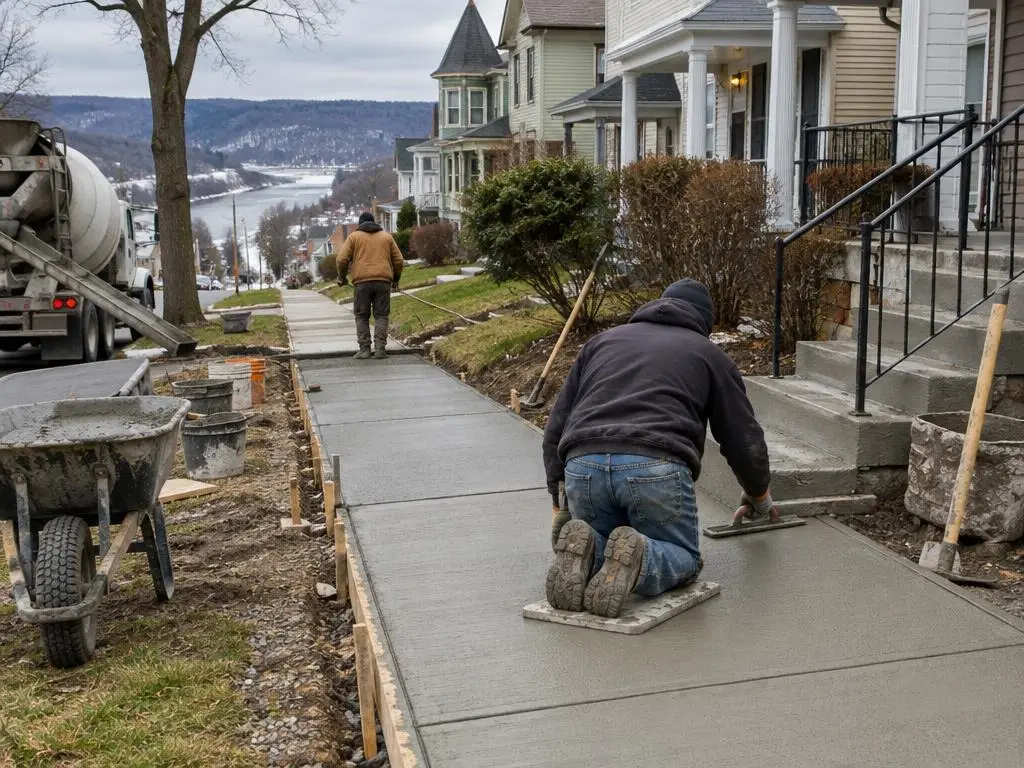
Most driveway failures start below the surface. We remove the old concrete or asphalt, dig out soft or organic soil, and replace it with crushed stone compacted in layers. That base carries the load and lets water drain away instead of freezing under the slab. Forms are set so the surface pitches toward the street or yard and away from the garage and foundation.
HomeGuide's driveway guide calls for at least 4 inches of concrete for ordinary cars and 5 to 6 inches for RVs or heavy vehicles, with edges of 6 to 8 inches. If a pickup with a plow, a trailer or a camper parks on the drive, we thicken that area. The concrete is air-entrained to resist freezing, reinforcement is placed mid-slab where the design calls for it, and control joints go in on a planned grid so cracks run where we want them.
Where the drive meets the street
In the City of Binghamton, the public sidewalk that crosses many driveways is the owner's responsibility, and work in the right of way needs a Street Work Permit from the Department of Engineering. If your driveway project includes the sidewalk crossing or the curb, we plan for that permit and tell you whether the city's Curb & Sidewalk Assistance Program may cover part of the walk.
Finish choices
- Broom finish: the standard. The light texture gives grip in rain and slush.
- Exposed aggregate: stone showing at the surface, good traction and it hides tire marks.
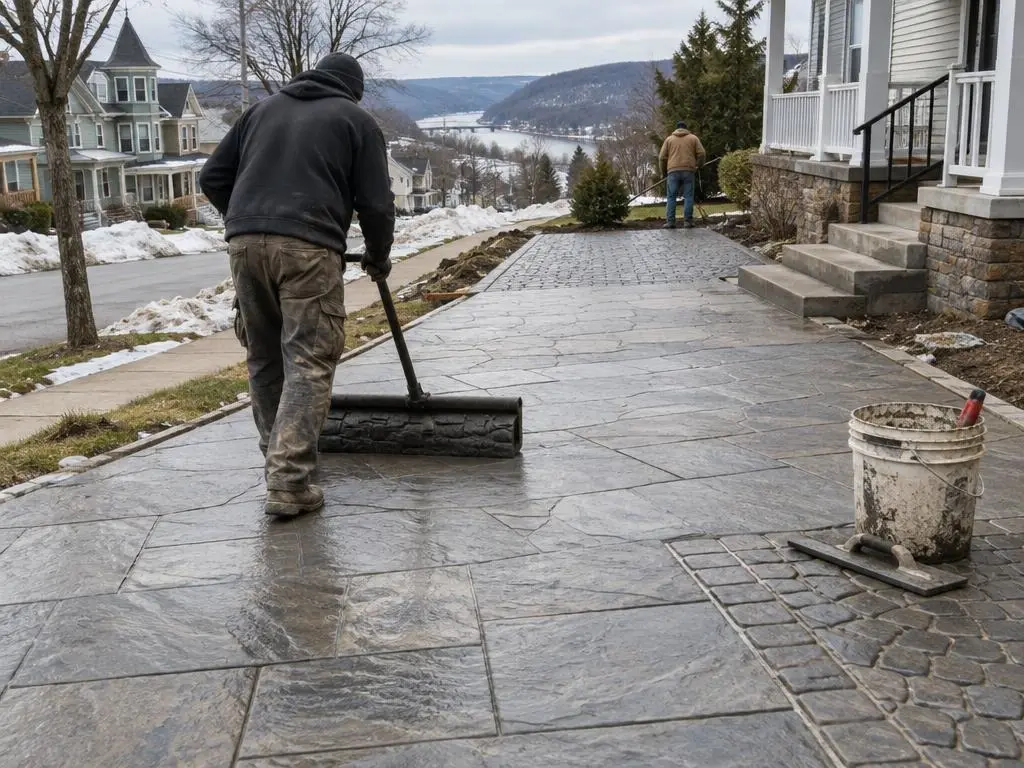
- Stamped or colored borders: decoration along the edges, with plain lanes that are easy to shovel.
- Smooth trowel: neat but slick when wet or icy, so we keep it off sloped drives.
The first year
Keep cars off for at least 7 days and heavy vehicles off for about 30, as HomeGuide recommends. Do not use rock salt the first winter; use sand for traction. After that, avoid de-icers with ammonium nitrate or ammonium sulfate. HomeGuide advises waiting 28 to 30 days before the first coat of sealer and resealing every 2 to 3 years. Ask whoever plows to use a rubber edge or keep the blade slightly raised.
What the Driveway Price Covers
Each of these is a separate line on your quote.
Removal and hauling
Old concrete, asphalt or gravel broken out and taken away, plus soft soil below it.
Stone base
Crushed stone compacted in layers for firm support and drainage.
Grading and forms
Forms set so water runs away from the garage and house.
Reinforcement
Rebar or wire mesh placed mid-depth where size and loads call for it.
Pour and joints
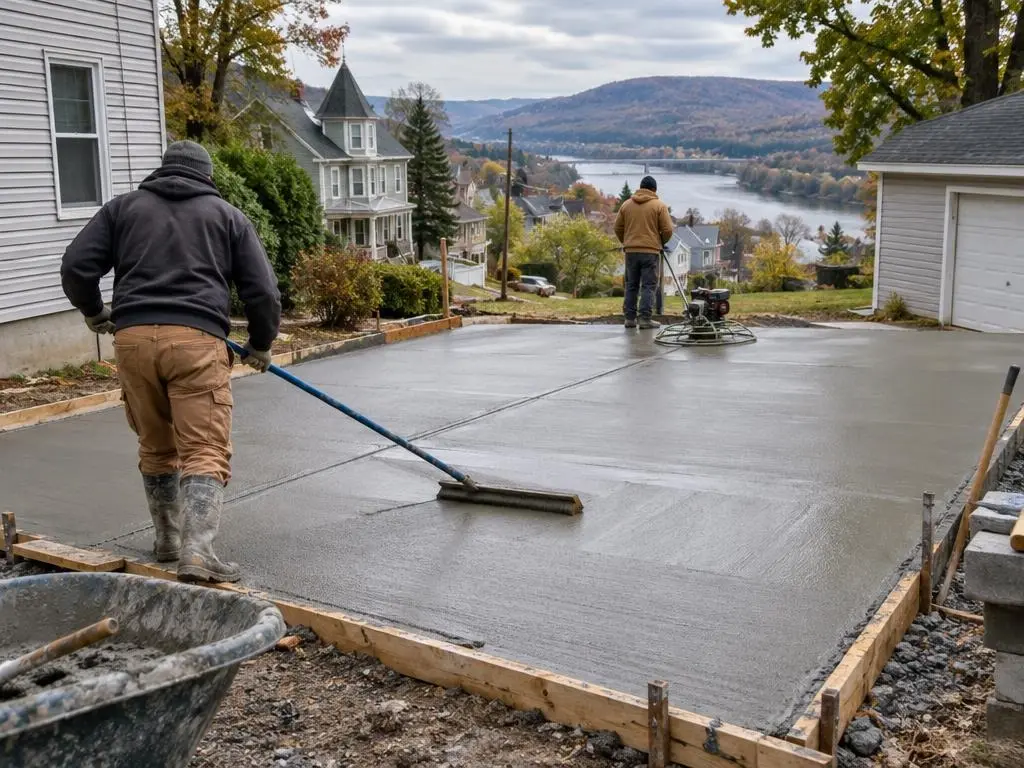
Air-entrained concrete, broom finish and control joints on a planned layout.
Widening and pads
Extra width, side parking pads and turnarounds tied into the drive.
Typical Concrete Driveway Costs
| Item | Published range |
|---|---|
| Standard driveway, per sq ft installed | $6 to $10 |
| Basic decorative, per sq ft | $10 to $15 |
| One-car, 12 x 24 ft | $1,700 to $4,300 |
| Two-car, 20 x 20 ft | $2,400 to $6,000 |
| Two-car, 24 x 24 ft | $3,500 to $8,600 |
| Removing an old driveway, per sq ft | $2 to $6 |
| Rebar, per sq ft | $1 to $3 |
| Sealing, per sq ft | $1 to $3 |
Figures from HomeGuide's concrete driveway cost guide (national averages). Binghamton prices can run higher or lower, and removal, access, grade and finish all change the total. Your written estimate after measuring is the price.
Start to Finish
1. Measure and quote
We measure, check drainage and the street side, then write up the price.
2. Tear-out and base
Old surface removed, soft soil dug out, stone compacted.
3. Pour
Forms, reinforcement, air-entrained concrete, finish and joints.
4. Cure and handoff
You get written dates for driving and sealing.
Why Choose Us for Concrete Driveways
Sized for your vehicles
Thicker concrete where trucks, plows or trailers park.
Street side planned
Sidewalk crossing and permit sorted out before the pour.
Concrete Driveways Questions
How thick should a driveway be?
HomeGuide's guide says at least 4 inches for ordinary cars and 5 to 6 inches for RVs or heavy vehicles, with edges of 6 to 8 inches. We add depth where a plow truck or trailer will sit.
Can you pour over my old driveway?
We rarely recommend it. A new layer over a cracked, sunken drive picks up the same cracks and raises the surface at the garage and the street. Removing the old slab and building a proper base is the dependable way.
How long until I can park on it?
HomeGuide recommends at least 7 days for cars and the full 30-day cure for heavy vehicles. We give you exact dates based on the mix and the weather that week.
Do I need a permit for a new driveway in Binghamton?
Work in the public right of way, such as the sidewalk crossing or curb, needs a Street Work Permit from the Department of Engineering. We confirm what else your address needs before scheduling.
How long will it last?
HomeGuide lists 30 to 40 years for a well-built, maintained concrete driveway. Sealing every 2 to 3 years and avoiding ammonium de-icers help it reach the top of that range.
Concrete Driveways Service Areas
- Concrete Contractors in Binghamton, NY
- Concrete Contractors in Vestal, NY
- Concrete Contractors in Johnson City, NY
- Concrete Contractors in Endicott, NY
- Concrete Contractors in Endwell, NY
- Concrete Contractors in Union, NY
- Concrete Contractors in Kirkwood, NY
- Concrete Contractors in Conklin, NY
- Concrete Contractors in Chenango, NY
- Concrete Contractors in Chenango Bridge, NY
- Concrete Contractors in Port Dickinson, NY
- Concrete Contractors in Dickinson, NY
- Concrete Contractors in Fenton, NY
- Concrete Contractors in Hillcrest, NY
- Concrete Contractors in Town of Binghamton, NY
- Concrete Contractors in Maine, NY
- Concrete Contractors in Whitney Point, NY
- Concrete Contractors in Owego, NY
- Concrete Contractors in Apalachin, NY
- Concrete Contractors in Windsor, NY
- Concrete Contractors in Colesville, NY
- Concrete Contractors in Greene, NY
- Concrete Contractors in Newark Valley, NY
- Concrete Contractors in Lisle, NY
- Concrete Contractors in Barker, NY
Get a Concrete Driveways Estimate
We measure your driveway and price it in writing, in Binghamton and nearby towns.